
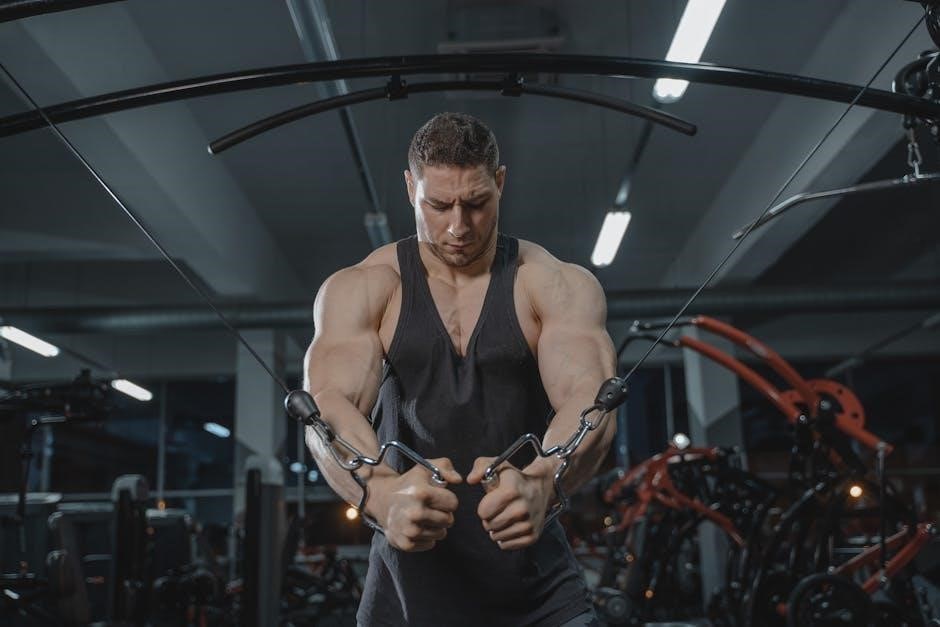
cable machine exercises pdf
Cable Machine Exercises PDF: A Comprehensive Guide
Discover a versatile training tool! Explore comprehensive guides and printable workouts utilizing cable machines for full-body fitness, enhancing strength and versatility.
Cable machines represent a cornerstone of modern gym equipment, offering a unique and adaptable training experience. Unlike free weights, cables provide constant tension throughout the entire range of motion, maximizing muscle engagement and minimizing momentum. This makes them ideal for both beginners and seasoned athletes.
Versatility is a key attribute; a single cable machine can facilitate hundreds of exercises targeting every muscle group. From foundational movements like rows and squats to isolation exercises for biceps and triceps, the possibilities are extensive. Furthermore, the adjustable weight stacks allow for precise resistance control, catering to various strength levels.
Unlike many machines, cable pulleys have proven their lasting value, becoming a staple in gyms worldwide. They offer a smooth, controlled movement, reducing the risk of injury and promoting proper form. Exploring cable machine exercises opens doors to a more efficient and effective workout routine.
Benefits of Using Cable Machines
Cable machines offer a multitude of advantages for fitness enthusiasts. Constant tension throughout each exercise maximizes muscle fiber recruitment, leading to greater strength gains and hypertrophy. This contrasts with free weights where gravity’s pull can lessen tension at certain points.

Versatility is another significant benefit; one machine can replace an entire rack of dumbbells and barbells. This saves space and simplifies workout planning. Moreover, cables promote functional movement patterns, mimicking real-life activities and improving overall athleticism.
Isolation of specific muscle groups is easier with cables, allowing for targeted training. They are also safer than free weights, particularly for beginners, due to the controlled resistance. Ultimately, incorporating cable exercises into your routine can elevate your fitness journey.
Upper Body Cable Exercises
Target your chest, back, shoulders, and arms with effective cable movements! Sculpt a stronger, more defined upper body through versatile and isolating exercises.
Chest Exercises
Cable exercises offer a unique advantage for chest development, providing constant tension throughout the entire range of motion – unlike free weights. This consistent resistance maximizes muscle fiber recruitment, leading to greater strength gains and hypertrophy. Cable flyes are a fantastic isolation exercise, allowing you to really focus on squeezing the pectoral muscles.
Cable crossovers, performed with adjustable pulleys, enable you to target different areas of the chest by altering the angle of resistance. This versatility is key to a well-rounded chest workout. Unlike many machines, the cable pulley has stood the test of time, proving its effectiveness. Remember to maintain proper form and control during each repetition to prevent injury and optimize results.
Cable Flyes
Cable flyes are an exceptional isolation exercise for the pectoral muscles, offering a constant tension that dumbbells sometimes lack. Set the pulleys to chest height and grab the handles, stepping forward to create tension. Focus on bringing your hands together in a smooth, arcing motion, squeezing your chest muscles at the peak contraction.
Maintain a slight bend in your elbows throughout the exercise to protect your joints. Control the eccentric (negative) portion of the movement, resisting the pull of the cables as you return to the starting position. Unlike free weights, cables provide consistent resistance. Remember to breathe properly – exhale during the contraction and inhale during the extension.
Cable Crossovers
Cable crossovers are a fantastic variation of the cable flye, allowing for a greater range of motion and a more focused contraction of the pectoral muscles. Position yourself between two cable machines with the pulleys set high. Grab the handles and step forward, creating tension in the cables.
Bring your hands together in front of your lower chest, maintaining a slight bend in your elbows. Focus on squeezing your chest muscles together as your hands meet. Control the movement throughout the entire range, resisting the pull of the cables on the return. This exercise is versatile, targeting different areas of the chest based on hand position.

Back Exercises
Strengthening your back is crucial for posture, stability, and overall fitness. Cable machines offer excellent options for targeting various back muscles with controlled resistance; Cable rows, both seated and standing, provide a consistent tension throughout the movement, unlike free weights.
Lat pulldowns with a cable mimic the traditional exercise but allow for different grip variations and a more natural arc of motion. Focus on squeezing your shoulder blades together during each repetition, engaging the lats and rhomboids. Proper form is essential to avoid injury and maximize effectiveness. These exercises build a strong and defined back.
Cable Rows (Seated & Standing)
Cable rows, performed both seated and standing, are foundational back exercises offering consistent tension. Seated cable rows provide stability, isolating the back muscles effectively. Maintain a straight back, pulling the handle towards your abdomen while squeezing your shoulder blades.
Standing cable rows engage your core for added stability, mimicking a more functional movement pattern. Experiment with different handle attachments – straight bars, V-bars, or rope – to target different areas of your back. Focus on controlled movements, avoiding jerking or using momentum. Adjust the weight to challenge yourself while maintaining proper form for optimal results.
Lat Pulldowns with Cable
Cable lat pulldowns offer a unique alternative to traditional machine pulldowns, providing constant tension throughout the movement. Attach a lat pulldown bar to the high pulley and kneel or sit facing the machine. Pull the bar down towards your upper chest, squeezing your shoulder blades together.
Maintain a slight bend in your elbows and avoid arching your back excessively. Focus on using your latissimus dorsi muscles to initiate the pull, rather than your arms. Experiment with different grip widths – wide, medium, or close – to target different areas of your back. Control the eccentric phase, slowly returning the bar to the starting position.
Shoulder Exercises
Cable exercises are fantastic for sculpting well-rounded, strong shoulders. Unlike free weights, cables provide constant tension throughout the entire range of motion, maximizing muscle activation. Focus on controlled movements and proper form to prevent injury and optimize results. Utilize various attachments – straight bars, rope handles, or D-handles – to diversify your training.
Target all three deltoid heads – anterior (front), medial (side), and posterior (rear) – for balanced shoulder development. Incorporate exercises like cable front raises, lateral raises, and rear delt flyes into your routine. Remember to adjust the weight to challenge yourself while maintaining good technique.
Cable Front Raises
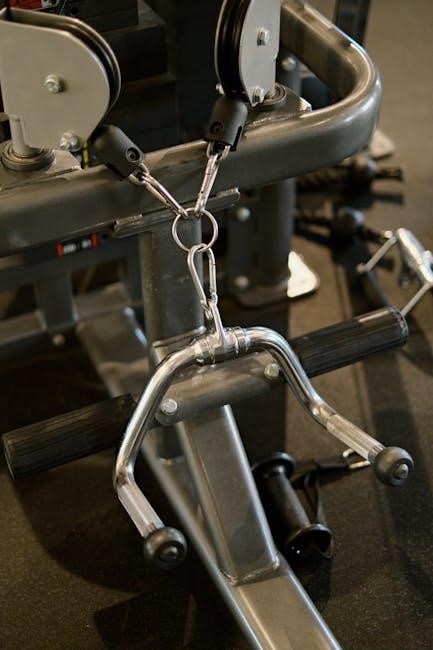
Cable front raises effectively isolate the anterior deltoids, contributing to well-defined shoulders. Attach a straight bar or rope handle to the low pulley. Stand facing the machine, maintaining a slight bend in your elbows throughout the exercise. Slowly raise the handle in front of your body to shoulder height, keeping your core engaged.
Focus on controlled movements, avoiding swinging or using momentum. Lower the weight back to the starting position with the same deliberate pace. Adjust the weight to challenge your muscles without compromising form. Perform 3-4 sets of 10-15 repetitions for optimal results. Remember to prioritize proper technique over lifting heavy weight.
Cable Lateral Raises
Cable lateral raises are excellent for developing the medial deltoids, broadening the shoulders and improving upper body aesthetics. Attach a D-handle or rope handle to the low pulley. Stand perpendicular to the machine, maintaining a slight bend in your elbows. Raise your arms out to the sides, keeping your palms facing down, until they reach shoulder height.
Avoid shrugging your shoulders or using momentum to lift the weight. Focus on a controlled, smooth movement throughout the exercise. Slowly lower the weight back to the starting position. Complete 3-4 sets of 12-15 repetitions. Prioritize form to maximize muscle activation and prevent injury. Consider adjusting the weight as you progress.
Arm Exercises
Cable machines offer fantastic isolation for both biceps and triceps, allowing for focused arm development. Unlike dumbbells, cables provide constant tension throughout the entire range of motion, maximizing muscle fiber recruitment. Target your biceps with cable curls, focusing on a controlled squeeze at the peak contraction.
For triceps, cable pushdowns are a staple, offering variations like rope, straight bar, and V-bar attachments to hit different parts of the muscle. Remember to keep your elbows tucked in during pushdowns for optimal triceps activation. Incorporate these exercises into your routine for sculpted and stronger arms!
Cable Bicep Curls
Cable bicep curls provide consistent tension, unlike free weights, leading to enhanced muscle activation. Attach a straight bar or rope handle to the low pulley. Stand facing the machine, maintaining a slight bend in your elbows throughout the exercise. Keep your core engaged and back straight to prevent swinging.
Curl the weight upwards, focusing on squeezing your biceps at the top of the movement. Slowly lower the weight back to the starting position, controlling the descent. Experiment with different handles to target various parts of the biceps muscle. Aim for 3-4 sets of 10-12 repetitions.
Cable Triceps Pushdowns
Cable triceps pushdowns are excellent for isolating and strengthening the triceps muscles. Attach a rope, V-bar, or straight bar to the high pulley. Stand facing the machine, keeping your elbows tucked close to your body. Maintain a slight bend in your elbows throughout the exercise.
Extend your arms downwards, focusing on contracting your triceps at the bottom of the movement. Avoid locking your elbows at the full extension. Slowly return to the starting position, controlling the upward motion. Vary your grip to target different heads of the triceps. Perform 3-4 sets of 12-15 repetitions.
Lower Body Cable Exercises
Target legs and glutes with dynamic resistance! Utilize cables for squats, lunges, and hip movements, improving strength, stability, and muscle definition effectively.
Leg Exercises
Cable squats offer a unique challenge to traditional squats, providing constant tension throughout the entire range of motion. This helps in developing explosive power and enhancing overall leg strength. Attach an ankle strap to the cable and perform squats, focusing on maintaining proper form and controlled movements.
Cable lunges are another excellent exercise for targeting the quads, hamstrings, and glutes. Similar to squats, the constant tension from the cable increases muscle activation. Perform lunges while connected to the cable machine, ensuring a stable core and controlled descent. These exercises are great for building lower body strength and endurance.
Remember to adjust the weight according to your fitness level and always prioritize proper technique to prevent injuries.
Cable Squats
Cable squats introduce constant tension, unlike free-weight squats, making them a powerful addition to your leg day routine. Attach an ankle strap to the low pulley and position yourself facing away from the machine. Maintain a stable core and upright posture as you descend into a squat, keeping your back straight.
Focus on driving through your heels to activate your glutes and hamstrings. The cable’s resistance challenges your muscles throughout the entire movement, enhancing strength and stability. Adjust the weight to match your fitness level, starting with a lighter load to master the technique.
Perform 3-4 sets of 10-12 repetitions for optimal results.
Cable Lunges
Cable lunges offer a unique challenge to traditional lunges by providing consistent tension throughout the exercise. Attach an ankle strap to the low pulley and position yourself with your back to the cable machine. Step forward into a lunge, maintaining a 90-degree angle in both knees.
Ensure your front knee stays aligned over your ankle and your core remains engaged for stability. Focus on driving through your front heel to return to the starting position. This exercise effectively targets your quads, glutes, and hamstrings, promoting balanced leg development.
Complete 3-4 sets of 10-12 lunges per leg for a challenging and effective workout.
Hip & Glute Exercises
Strengthen and sculpt your hips and glutes with targeted cable exercises. Cable movements allow for constant tension, maximizing muscle activation and promoting optimal results. Focus on controlled movements and proper form to prevent injury and enhance effectiveness.
These exercises are crucial for athletic performance, posture, and overall lower body strength. Incorporating cable hip abduction and adduction into your routine will help improve stability and balance. Remember to adjust the weight to match your fitness level and progressively increase it as you get stronger.
Prioritize quality over quantity for best results.
Cable Hip Abduction
Target the outer glutes and hip abductors with the cable hip abduction exercise. Attach an ankle strap to the cable machine’s lowest setting. Stand with the cable attached to your outer thigh, maintaining a slight bend in your knee. Slowly move your leg outwards, away from your body, keeping your core engaged and back straight.
Focus on squeezing your glutes at the peak of the movement. Control the return to the starting position, resisting the pull of the cable. This exercise improves hip stability and strengthens the muscles responsible for outward leg movement. Adjust the weight to challenge yourself while maintaining proper form.
Cable Hip Adduction (Inner Thigh Focus)
Isolate and strengthen your inner thigh muscles with cable hip adduction. Secure an ankle strap to the cable machine’s low pulley. Position yourself sideways to the machine, attaching the strap to the leg furthest from the machine. Maintain a slight bend in your standing leg and keep your core braced.

Draw your strapped leg across your body, focusing on squeezing your inner thigh muscles. Control the movement throughout the entire range of motion, avoiding momentum. Leg conditioning greatly emphasizes strengthening the inner thigh, making this exercise crucial. Adjust the weight to suit your fitness level and ensure proper form.

Core Cable Exercises
Engage your core with dynamic cable movements! Target abdominal and oblique muscles for enhanced stability and rotational power, improving overall fitness.
Abdominal Exercises
Strengthen and define your abdominal muscles with targeted cable exercises. Cable crunches provide constant tension throughout the movement, maximizing muscle engagement compared to traditional crunches. Adjust the cable height to focus on different areas of your abs – lower, upper, or oblique.
Cable Russian twists are another excellent option, challenging your obliques and core stability. Attach a rope handle to a high pulley and rotate your torso from side to side, keeping your core engaged. These exercises are incredibly versatile, allowing for progressive overload by increasing the weight. Remember proper form is crucial to prevent injuries and ensure effective muscle activation. Incorporate these into your routine for a stronger, more defined core!
Cable Crunches
Execute cable crunches by attaching a rope handle to the high pulley of a cable machine. Kneel facing away from the machine, holding the rope close to your face. Engage your core and curl your upper body forward, focusing on contracting your abdominal muscles.
Maintain a slight bend in your elbows throughout the movement. Avoid pulling with your arms; the motion should come from your abs. Slowly return to the starting position, controlling the resistance. Adjust the weight to match your strength level, prioritizing proper form over heavy weight. This exercise provides constant tension, enhancing abdominal development. Remember to breathe consistently throughout the set for optimal results and prevent strain.

Cable Russian Twists
Set up cable Russian twists by sitting on the floor facing a high pulley cable machine, attaching a rope handle; Lean back slightly, keeping your back straight and core engaged. Hold the rope with both hands and rotate your torso from side to side, bringing the rope towards each side of your body.
Focus on twisting from your core, not just moving your arms. Control the movement and avoid using momentum. Adjust the weight to challenge your obliques without compromising form. Maintain a slight bend in your knees and keep your feet slightly elevated for increased intensity. This exercise effectively targets your obliques and rotational core strength, enhancing stability.

Creating a Cable Machine Workout PDF
Compile your favorite cable exercises into a personalized PDF! Utilize online resources and templates for structured routines, optimizing your gym sessions effectively.
Resources for Printable Workouts
Finding pre-designed cable machine workout PDFs can significantly streamline your fitness journey. Numerous websites offer free downloadable routines catering to various fitness levels and goals. Explore platforms like Bodybuilding.com and Fitness Blender for a diverse selection of workouts targeting specific muscle groups.
Additionally, many personal trainers and fitness influencers provide downloadable PDFs through their websites or social media channels. Consider searching on Pinterest or Instagram using relevant keywords like “cable machine workout PDF” to uncover valuable resources. Remember to assess the credibility of the source before implementing any new workout routine.
For a more customized approach, utilize workout builder apps or spreadsheet templates to create your own printable PDF. This allows you to tailor the exercises, sets, and reps to your individual needs and preferences, ensuring a truly personalized and effective training experience.